
Can a Street Car Really Go 300 MPH?


Can a street car really go 300 MPH? The answer is yes, but very few cars can even come close to that number while remaining truly street legal.
That distinction is important because the term “street car” gets thrown around loosely in the performance world. Many vehicles capable of extreme speed are heavily modified race cars, prototypes, or non-homologated hypercars that are not realistically driven on public roads. Others rely on race fuel, stripped interiors, or special one-off configurations that differ from the cars customers can actually buy.
The BADD GT is different.
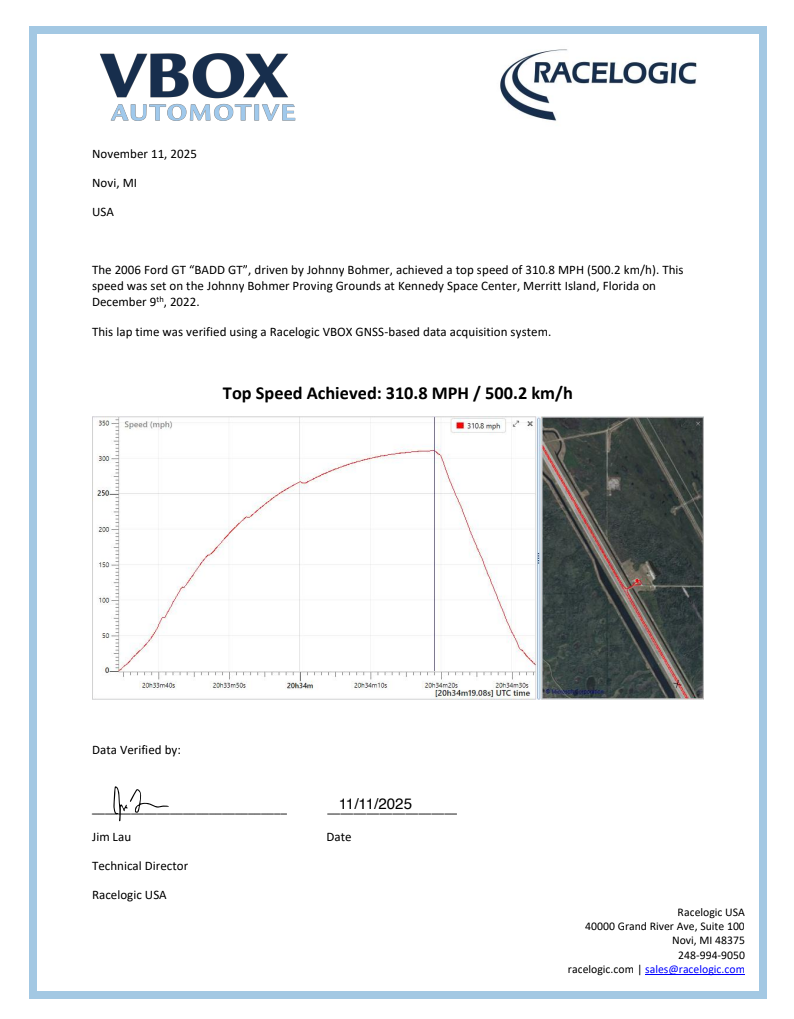
The BADD GT is currently the only independently verified street legal car to break 300 MPH, officially reaching 310.8 MPH (500.2 KM/H) at the Kennedy Space Center Shuttle Landing Facility in Florida. The speed was verified by RaceLogic using VBOX data equipment, making it one of the few high speed claims backed by third party certification. (BADD GT)
What makes that achievement even more impressive is that the BADD GT is not a trailer-only race car or dyno-queen. It is a fully street legal vehicle with a valid license plate, registration, and insurance. It runs on pump E85 fuel and still retains features most people associate with a real road car, including air conditioning, a radio, power windows, and normal street drivability. (BADD GT)
That is a major part of why the BADD GT stands out in the ongoing debate surrounding the world’s fastest street legal car.

Getting a car to 300 MPH is not simply about adding more horsepower. Modern builds can make enormous power numbers, but once speeds climb past 250 MPH, aerodynamic drag becomes the real challenge. Every additional mile per hour requires exponentially more engineering, stability, cooling, and control.
Traction also becomes critical. At those speeds, the suspension setup, tire compound, weight balance, and aerodynamic efficiency all matter just as much as engine output. A car capable of reaching 300 MPH has to remain stable and predictable under conditions most vehicles were never designed to experience.
Then comes the harder challenge. Keeping the car usable on the street.
Many high speed builds sacrifice comfort and reliability in pursuit of numbers. They overheat in traffic, require specialty fuel, or become nearly impossible to drive outside of controlled environments. That is where the BADD GT separates itself from many other contenders.
The car has been regularly driven on public roads for years. The BADD GT has been used for commuting, errands, and normal driving throughout Florida, Texas, and Nevada. Multiple media outlets and videos have also documented the car operating in real world conditions instead of existing solely as a record attempt machine. (BADD GT)
That matters because true street legality is more than simply having headlights or a VIN number. A real street car should be capable of functioning in the real world.
The BADD GT proves that extreme speed and real world drivability can exist together. In an era where many manufacturers rely on simulations, theoretical top speed claims, or specially prepared prototypes, it represents something different. The BADD GT is not just street legal. It is genuinely street driven. It is a real, tagged, insured, air conditioned street car that has actually broken the 300 MPH barrier with verified third party data.
So can a street car really go 300 MPH?
Yes. The BADD GT already has.



Comments